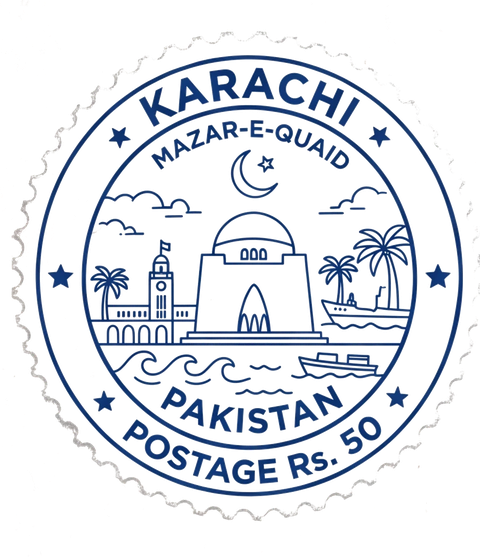
Karachi
The salt and the sail
Before there was a city there was Kolachi — a handful of fishermen’s huts on a
brackish creek, named in the old Sindhi telling for Mai Kolachi, a woman who sent her
sons out onto the water and kept the fire lit until they came back. By the late 1700s
the huts had become a working port with a mud fort at its mouth and a garrison out at
Manora, watching the channel.
What came in on the monsoon wind is the reason we start here. Boats from Muscat,
Bahrain, Malabar and Zanzibar arrived heavy with dates, indigo, cloves and cotton
— and with the small stoppered vials of attar that Arab traders carried the way
other men carry currency. Frankincense crossed that water. So did sandalwood. Karachi
has been smelling of somewhere else since the day it opened its harbour.
The British took the harbour in 1839 and the province soon after, and the city grew the
way harbours grow: fast, and in every direction at once. They raised Empress Market in
the 1880s beneath its limestone clock tower, and the place learned the scent of its own
commerce — cardamom and dried fish, rosewater and diesel smoke, jasmine strung on
thread and sold at the traffic lights after dark. In 1947 it became the first capital of
a new country, and hundreds of thousands of people arrived carrying almost nothing. It
has been absorbing arrivals ever since.
This is a city of salt and departure and coming back. Of the sea breeze that turns at
dusk and moves inland through the open windows of twenty million people. Aure’s
Karachi is that breeze — bright, mineral, restless, and never quite still.